Dress Code Guide
HOW TO DRESS APPROPRIATELY FOR THE OCCASION
Practical guidance for business meetings, cultural events, and formal receptions
A well-chosen outfit allows you to enter a room with confidence, feel at ease, and focus your attention on the people around you. A dress code helps guests understand in advance the degree of formality expected by their hosts.
This guide focuses primarily on European and Anglo-American practices. For international invitations, local customs, religious requirements, and the rules of the specific event should also be taken into account.
Throughout the guide, a distinction is made between dress-code requirements, acceptable alternatives, and practical recommendations. Suggested outfits are intended to provide guidance rather than exhaust every possible option.
Start by Reading the Invitation
Before choosing what to wear, establish several important details.
-
What exactly does the invitation say? Black Tie, Cocktail, and Smart Casual call for very different choices. Additional terms such as Optional or Creative can significantly alter the meaning.
-
What is the occasion? A business meeting, wedding ceremony, and festive dinner may all take place in the same hotel while requiring very different clothing.
-
When does the event take place? Daytime and evening formality have different traditions. A late starting time alone does not automatically mean Black Tie.
-
What does the programme involve? A seated dinner, dancing, a walk through a garden, or a religious ceremony may require different practical considerations.
-
Has the organiser provided additional rules? Check any information accompanying the invitation, the event page, and the venue requirements.
If the wording is unclear, ask for clarification beforehand.
Debrett’s explicitly recommends contacting the hosts when a dress code requires explanation.
It is usually more helpful to ask a specific question:
“Could you please let me know whether a full-length evening gown is expected, or whether an elegant midi dress would be appropriate?”
“Am I correct in understanding that gentlemen are expected to wear a dinner jacket, or would a dark suit and tie also be acceptable?”
This way, you are more likely to receive information that you can actually use.
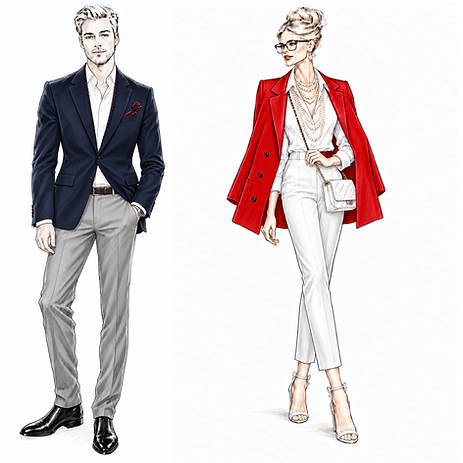
SMART CASUAL Dress Code
A Polished Look for a Relaxed Setting
Smart Casual calls for an outfit that is more considered and refined than ordinary clothes worn for errands, home, or casual leisure.
For women: a day dress, skirt, or trousers with a blouse, quality knitwear, or blazer.
For men: chinos or tailored trousers, a collared shirt, and, where appropriate, a jacket or blazer. A tie is generally optional.
Smart Casual may be interpreted more or less strictly.
In a traditional setting, it is sensible to choose leather shoes and avoid denim. At a more relaxed event, neat dark jeans may be acceptable. Much depends on the hosts and venue.
Practical guideline: if the setting is unfamiliar, choose an outfit that can easily be made more relaxed: remove the blazer, take off a statement piece of jewellery, or undo the top button of a shirt.
Occasion: everyday meetings and informal socialising
.png)
Business Casual
Less Formal Professional Attire
Business Casual retains the professional character of business dress while allowing some departure from a full suit.
For women: trousers or a skirt with a blouse, shirt, or understated knitwear; a business dress; and a blazer where appropriate.
For men: trousers with a shirt, sometimes a polo shirt or jumper; a separate jacket or blazer; generally without a mandatory tie.
Unless otherwise specified, neat closed-toe footwear is a reliable choice. Jeans and trainers should be worn only where they are genuinely accepted within the organisation’s corporate culture.
The Emily Post Institute emphasises that Business Casual should be understood in relation to the usual dress standards of the particular organisation. In a company where suits are worn every day, a more relaxed dress code may simply mean removing the tie.
Practical guideline: when preparing for a first meeting with a client, dress for the format and expectations of that meeting, even if your own office has a more relaxed culture.

Business Formal
Formal Business Attire
For women: a trouser suit or skirt suit, a business dress, and, where appropriate, a blazer or jacket. Restrained colour combinations and accessories that reinforce a professional appearance are generally preferable.
For men: a dark suit, shirt, understated tie, and classic leather shoes.
Specific requirements regarding skirt length, hosiery, and other details may be established by the organisation or host.
Practical guideline: try on the complete outfit while seated. Make sure you can work comfortably at a table, that fastenings do not pull apart, and that you will not need to keep adjusting your clothing.
NUANCE: Lounge Suit. The Suit Dress Code
This term is encountered primarily in British practice.
For men, it means a conventional suit with a shirt and tie.
For women, an elegant day dress, trouser suit, or skirt-and-jacket combination is appropriate.
For an evening event, the look may be made more formal with a smaller handbag and evening accessories.
Lounge Suit appears on both business and social invitations. The precise choice of details depends on the occasion and time of day.
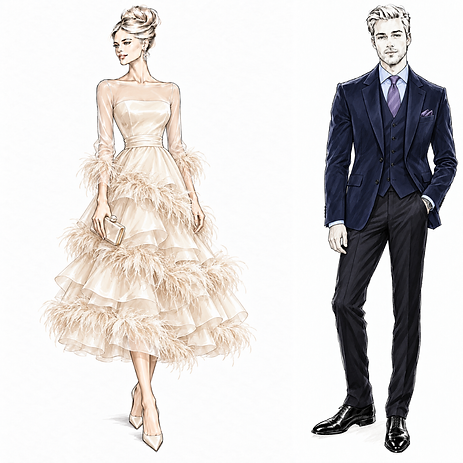
Cocktail Attire
Elegant Social Attire
Cocktail indicates festive clothing while allowing a considerable degree of choice.
For women: a cocktail dress, an elegant trouser ensemble, or a skirt with a statement top. Knee length or midi length is a useful guideline. A long, streamlined silhouette may also work if it suits the scale and character of the event. The volume and grandeur of a full ball gown would generally be excessive.
Shoes may have heels or be flat; what matters is their overall character and how well they complement the outfit.
For men: a suit or an elegant combination of jacket and trousers.
Whether a tie is expected depends on the level of formality.
Contemporary interpretations allow more expressive shirts, textures, and accessories than traditional business attire.
Practical guideline: for a formal reception where you do not know the other guests, choose a more classic interpretation. For a creative party, you can introduce a stronger colour or an unusual detail.
NUANCE:
Semi-Formal Dress Code - A Term That Must Be Read in Context.
In contemporary American practice, Semi-Formal is often close to Cocktail. For evening events, women may wear a cocktail dress or elegant trouser suit, while men may wear a dark suit. Daytime interpretations may be more restrained.
However, Semi-Formal should not automatically be interpreted as “almost casual.” The occasion and local tradition remain important.

Black Tie
Formal Evening Dress
For men: a dinner jacket/tuxedo with matching trousers, a white evening shirt, black bow tie, and black formal footwear. A waistcoat or cummerbund should be selected to suit the ensemble.
An ordinary business suit with a long black necktie is not the traditional interpretation of Black Tie.
For women: the most reliable choice for a formal evening is a full-length gown made from fabric with an appropriately evening character. Vogue recommends this as the safest reference point.
However, the statement that “Black Tie always permits only a floor-length gown” is too categorical. Debrett’s allows cocktail dresses and certain forms of evening trousers. Their appropriateness depends on the level of formality of the particular reception.
The dress may be any suitable colour: the word black refers to the traditional male evening ensemble. Jewellery may include both fine jewellery and high-quality costume jewellery. The handbag should be appropriate for eveningwear.
Practical guideline: for an unfamiliar formal reception, choose the most traditional interpretation. If you would like to wear an evening trouser ensemble, clarify the hosts’ expectations in advance.

Creative Black Tie
A vivid version of Black Tie
Creative Black Tie preserves the formality of evening dress while allowing greater freedom with colour, texture and accessories. The Emily Post Institute defines it as a black-tie foundation with room for individual expression.
For women: A floor-length evening gown or an appropriately formal cocktail dress, with distinctive accessories. Creativity might appear in an unusual silhouette, elaborate embroidery or a striking colour combination. These are styling possibilities, rather than compulsory elements. Emily Post explicitly includes both long gowns and dressy cocktail dresses within this code.
An elegant evening trouser ensemble may also be appropriate: Debrett’s recognises evening trousers within black-tie dressing.
Choose fabrics and accessories that establish a clearly evening character, and consider the host’s expectations. Complete the outfit with suitable evening shoes and a small, elegant bag.
For men: A tuxedo remains the foundation, with scope to vary selected details. Emily Post gives examples such as a black shirt or a coloured or patterned bow tie with a coordinating cummerbund. These departures are options permitted by the creative wording; they should not automatically be carried over to a traditional Black Tie invitation.
Practical guidance: Start with a complete evening outfit, then choose where you would like to introduce personality. One expressive focal point can be an effective approach, although it is a styling recommendation rather than an etiquette rule. If the invitation includes a theme, an accessory or carefully chosen detail may be enough to acknowledge it. Ask the host when the intended degree of experimentation is unclear.

White Tie
The Highest Level of Evening Formality
This rare dress code requires particularly careful observance of traditional rules.
For men: a black evening tailcoat, matching trousers, a specialised white evening shirt, white waistcoat, and white bow tie. A dinner jacket/tuxedo is not a substitute.
For women: a formal full-length evening gown. Cocktail length is not consistent with the traditional White Tie dress code.
Long evening gloves are traditional, although they are not mandatory at every contemporary event. If worn, gloves should be removed before eating.
Tiaras, orders, and decorations are governed by separate protocol. The presence of a White Tie dress code does not in itself mean that a guest should add any of these elements.
Practical guideline: organise such an outfit well in advance. Professional assistance is particularly useful when arranging traditional White Tie menswear.
Sources and Further Reading
Professional Etiquette Sources
-
Debrett’s. Events and Dress Codes. Principal formal dress codes and requirements relating to specific details.
-
Debrett’s. Addressing the Dress Code; Do Dress Codes Matter?; Deconstructing Dress Codes. Interpretation of invitations, Smart Casual, and contemporary variations.
-
Debrett’s. How to Be a Great Wedding Guest; Royal Events. Requirements relating to specific social and ceremonial contexts.
-
The Emily Post Institute. Attire Guide: Dress Codes from Casual to White Tie.
-
The Emily Post Institute. Black Tie Dress Code; Business Casual Attire; Wedding Guest Attire.
Fashion Interpretation and Specific Institutional Rules
-
Vogue. A Definitive Guide to Cocktail Attire; A Festive Guide to Nailing Cocktail Attire for Men.
-
Vogue. The Black-Tie Dress Code; What Is White Tie?. Provisions were used where consistent with professional etiquette sources.
-
Royal Ballet and Opera. Your First Visit to the Ballet or Opera. An example of official requirements established by a specific cultural institution.
Further Reading
-
STILS: noteikumi, prakse, konteksts. Editor-in-chief Guna Leiškalne-Roka; texts by Guna Leiškalne-Roka, Deniss Ševeļovs, and Jūlija Malahova. Riga: Stila ceļvedis, 2018. ISBN 978-9934-19-604-1. Bibliographical details verified through the National Library of Latvia. The book is included for further reading; its structure and content have not been reproduced in this edition.